ORDER YOUR COPY:
|
| Reviews |
Diane Beebe, MD, Professor Emeritus and Past Chair Department of Family Medicine, University, Mississippi School of Medicine. Past Chair American Board of Family Medicine (ABFM):
“Dr. Milhorn has done a Herculean job to create this textbook for ambulatory primary care providers that is current and comprehensive. Each section covers the basics of pathophysiology, signs and symptoms, diagnosis, and treatment. The content is presented in a way that is easy to use and understand with excellent supporting photographs and tables. Additionally, the references are extensive and current. I can definitely see using this resource not only in clinical practice, but for exam review and preparation.”
Lee Valentine, DO, Medical Director Mississippi State University Physician Assistant Program and past Program Director of EC Healthnet Family Medicine Residency Program:
“If you are looking for a concise, informative, and well written quick reference for family physician residents, physician assistants, nurse practitioners, or busy family physicians. Look no further. Ambulatory Medicine by Dr. H. Thomas Milhorn distinguishes itself as the premier reference guide, textbook, and board review source on the market today; it is in a class all by itself.”
|
|
|
|
| Books by H. Thomas Milhorn, MD, PhD |
| r t |
|
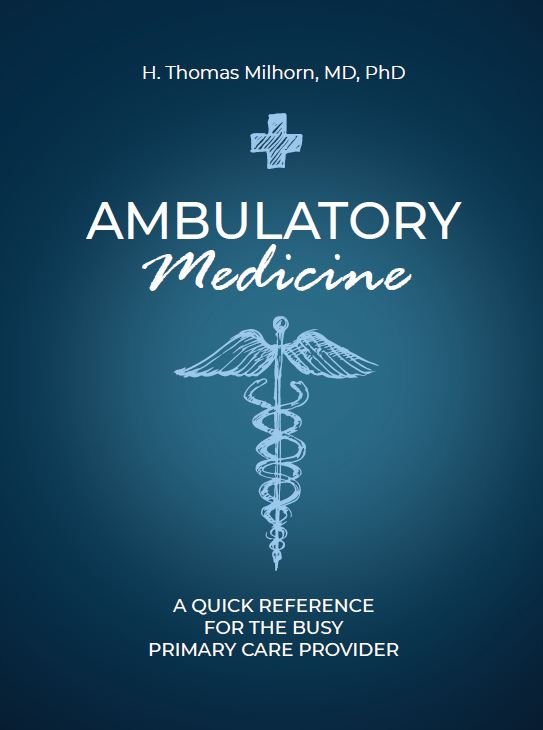
Ambulatory Medicine: A Quick Reference for the Busy Primary Care Provider
ISBN 10: 1627344152,
ISBN 13: 9781627344159
Ambulatory Medicine is medical care that takes place outside the hospital (outpatient care). It is the first resource for patients. Primary care providers provide this care. They include family physicians, internists, pediatricians, geriatricians, gynecologists/obstetricians, nurse practitioners, and physician assistants.
Overall, primary care providers offer services from head to toe and from birth to death. Services include disease prevention. Infectious disease prevention through immunizations, hypertension and diabetes sequelae prevention, osteoporotic fracture prevention) and screenings (hypercholesterolemia, hypertension, osteoporosis, cervical cancer, lung cancer), diagnosis and treatment of many types of illnesses (diabetes, hypertension, hypothyroidism, carpal tunnel syndrome). They also provide non-disease care, including birth control and obstetrical care. They provide education related to disease prevention and treatment, injury care (laceration repair, fracture and sprain care), counseling on many topics, including smoking cessation and weight loss, and coordination of care through subspecialists.
This book began as a manual for family medicine residents. Over time it evolved into a fairly complete coverage of most of the outpatient issues seen in their training. In response to their encouragement, I set out on the journey to convert the manual into the manuscript for this book, which was no small task. The book is seen as serving three purposes: (1) as a quick reference to use in the clinic when seeing patients, (2) as a textbook to replace the leading textbook of family medicine which is now out of print, and (3) a study guide for board examinations. I would like to thank Dr. Lee Valentine for working with Dr. Logan Rush to obtain some of the dermatology pictures. And of course, I would like the thank the EC Healthnet family medicine residents for their support and encouragement in this endeavor. |
Chapter 1: Allergy
Chapter 2: Cardiovascular
- Part I: The Heart
- Part II: The Vasculature
- Part III: Other
Chapter 3: Dermatology
Chapter 4: Electrolytes
Chapter 5: Endocrinology
Chapter 6: Gastrointestinal
- Part I: GI Tract Disorders
- Part II: Accessory Organ Disease
- Part III: Other GI Disorders
Chapter 7: Hematology
- Part I: Red Blood Cells
- Part II: White Blood Cells
- Part III: Platelets
- Part IV: Other
Chapter 8: Infectious Disease
- Part I: Bacterial Infections
- Part II: Viral Infections
- Part III: Tick-borne Disease
- Part IV: Protozoan Infections
- Part V: Sexually Transmitted Illnesses
Chapter 9: Men’s Health
- Part I: Breast Disorders
- Part II: Penile Disorders
- Part III: Scrotal Disorders
- Part IV: Other Disorders
Chapter 10: Miscellaneous
Chapter 11: Muscle Disorders
Chapter 12: Neurology
- Part I: Central Nervous System Disorders
- Part II: Peripheral Nervous System Disorders
Chapter 13: Oncology
- Part I: Dermatologic Cancers
- Part II: Endocrine Cancers
- Part III: Gastrointestinal Cancers
- Part IV: Head and Neck Cancers
- Part V: Hematologic Cancers
- Part VI: Neurologic Cancers
- Part VII: Pulmonary Cancers
- Part VIII: Reproductive System Cancers
- Part IX: Urinary System Cancers
- Part X: Tumor Markers |
Chapter 14: Ophthalmology
- Part I: Eye Disorders
- Part II: Eyelid Disorders
- Part III: Orbit Disorders
- Part IV: Ocular Manifestations of Autoimmune
Disease
Chapter 15: Orthopedics
- Part I: Vertebral Column Disorders
- Part II: Upper Extremity Disorders
- Part III: Lower Extremity Disorders
- Part IV: Other Orthopedic Problems
Chapter 16: Otolaryngology
Chapter 17: Pain
Chapter 18: Pediatrics
- Part I: Infection
- Part II: Other Disorders
- Part III: Infant Issues
Chapter 19: Preventive Medicine
Chapter 20: Psychiatry
- Part I: Substance Use Disorders
- Part II: Psychiatric Disorders
Chapter 21: Pulmonary
Chapter 22: Rheumatology
- Part I: Rheumatologic Tests
- Part II: Inflammatory (Rheumatic) Disorders
- Part III: Autoimmune Diseases
Chapter 23: Sexual Disorders
- Part I: Male Sexual Disorders
- Part II: Female Sexual
Disorders
- Part III: Paraphilias
Chapter 24: Surgery
Chapter 25: Urology/Nephrology
Chapter 26: Weight Problems
Chapter 27: Women’s Health |
|